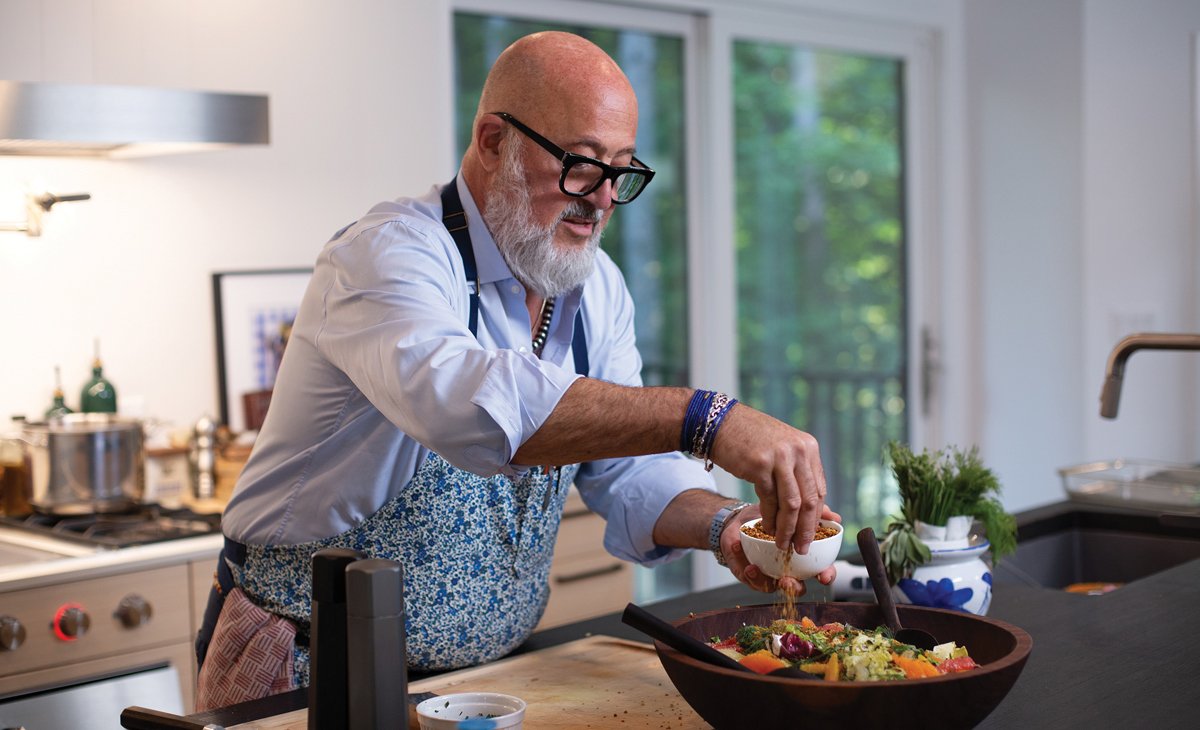
Andrew Zimmern / Photo by Madeleine Hill
Andrew Zimmern, celebrated chef, writer, and television personality, is an adventurous, passionate storyteller, a media producer, and a person devoted to long-term recovery. In this interview, edited for clarity and length, Zimmern shares insights into his early life, his work, and sobriety.
“I had a childhood that anyone would envy. My father ran a big company. We had a lovely first home, a second home. On the outside, I had every advantage, and on the inside, none of it was good enough. I remember having feelings way before my first drink that I would later define as alcoholic ones. I wanted things that I didn’t have. I thought I needed things I didn’t have. I thought other people were the reason I didn’t have those things. I constantly blamed the world for all my problems.
We had a series of family tragedies that culminated in a horrific accident involving my mother while my parents were divorced. My father went to his downtown apartment and left me at my mom’s apartment with housekeepers, etc., to take care of me. I didn’t know it at the time, but that abandonment had a very, very profound effect on me. I didn’t want to feel the feelings I was feeling. Instead, I just dove headlong into the very easily obtainable – in the mid 70s in New York City – world of pills, hallucinogens, booze, and weed. By the time I graduated high school, I had bought heroin and loved it. I was not a regular user, yet. Somehow, I managed to graduate college.
When it came to work, I was very successful. I had one of those double lives – successful restaurant guy by day – Dracula-drug-addict by night. People didn’t know I’d become a regular, daily heroin user. So that I could work and not be incapacitated, I mixed cocaine with heroin. I snorted this mixture all day long at work. It kept me evened out. As I began to have profound, serious consequences, the idea occurred to me, ‘Well, drugs are the problem.’ I quit all my hard drugs. I kept drinking and taking pills, weaning off pills about two years before I sobered up. It was the worst two years of my life. When I solely used alcohol, my life became so unmanageable that I wound up homeless, living in an abandoned building in lower Manhattan, stealing to support myself. I had become purely a user of people and a taker of things. I also crossed every moral boundary there was to cross.
I eventually checked into a fleabag hotel called the San Pedro. I ate a fist-full of barbiturates and chugged vodka. My intent was to kill myself. As best we can tell, I almost did the job, but I woke up two days later. I wasn’t dead. I did something I’d never done in my entire life, which was call another person, and ask for help. That was the biggest change for me. Within a matter of days, I had another intervention. The difference was this time I was willing to go wherever they sent me. I went to Hazelden for five weeks then to their halfway house in St Paul, where I stayed five or six months. That’s what kick-started this sobriety in January 1992.”
Congratulations. How did you get from a halfway house to creating “Bizarre Foods,” writing books, and becoming a media producer? Did you go back into the restaurant business? If so, how did you stay sober?
“Well, at the halfway house, I needed to get a job. I got a spot-job for a week washing dishes. That was miserable, so I got a job as a dishwasher at a coffee shop/diner. I leveraged up to dishwasher in a restaurant, an ambitious Minneapolis French bistro, with 125 seats. About three weeks in, one of their cooks was sick. I told them I could do the job. That day, I helped put out lunch on that person’s shift. The owner of the restaurant pulled me aside and asked, ‘Why is my dishwasher putting out food that looks nicer than my chef’s?’ I told him that I’d had a robust, extensive culinary career before I crashed and burned in New York.
I had one of those double lives – successful restaurant guy by day – Dracula-drug-addict by night.Once I got out of the halfway house, I wound up taking over that kitchen. We turned it very quickly into the best restaurant in the city. A lot of great food people come to Minnesota for treatment – from Florida, California, New York. I put up signs at halfway houses and recovery places that a sober kitchen was looking for help. Some really rock star folks cooked with us. It was a wonderful time – doing great things with bad restaurants.
I had bigger stories to tell. I desired a bigger audience. I started writing for a local magazine, working at a local TV station, and doing an hour-long radio show on weekends. I sort of taught myself the media business. After I got enough tape from those local shows, I started pushing ideas around. One of those ideas became “Bizarre Foods”. It was wonderful to take a tiny kernel of an idea and pitch it to a television network. They liked it. I found a production partner. We made the pilot in 2005, shot the first season in 2006, and in 2007 the show premiered. The first episodes did well. On the third episode, an Ecuadorian shaman performed an exorcism on me in a tiny little town called Otavalo. That tape found its way to the bookers for “The Tonight Show.” I went on that show the end of the same week that the exorcism episode aired. “Bizarre Foods” just blew up. If it wasn’t for this one booker on Jay Leno’s show, I’d be painting houses right now.”
Your fishing episode in Uganda on ‘Bizarre Foods’ was wild. Why do you not only explore food cultures, but take on dangerous activities to get that food?
I was very, very strict about my boundaries around alcohol. I desperately didn’t want to go back to that horrific hell hole I’d worked so hard to escape.“I like the danger! [Interviewer laughs] I’m serious. I wanted to tell stories using patience, tolerance, and understanding so that people could see all the different sides of a culture through the food. When I first pitched the show that way, it wasn’t met with success. One person at the Travel Channel took the time to tell me that it was too much like PBS – 80% education, 20% entertainment – but if I flipped it around, it would be very successful. So, I flipped it. I focused the show entirely on fringe foods – dishes most people hadn’t heard of outside their country or even outside their of origin. That little change not only sold the show but gave it lasting power.
And obviously, if you’re going to eat birds’ nests built by swallows on the side of cliffs, you’re going to have to go to dangerous places to get them. I could eat them in a restaurant in Chinatown in Queens, but that’s not half as fun as finding them in Thailand or the Philippines. Finding food at its source is way more thrilling. Yes, it comes with a certain amount of danger, but I found that exciting as well.”
Do you avoid foods that contain alcohol? Or does cooking change the equation?
“The first 5 – 10 years were a lot different than the last 5 – 10. I cooked with it professionally but avoided alcohol in all forms. I was very, very strict about my boundaries around alcohol. I desperately didn’t want to go back to that horrific hell hole I’d worked so hard to escape. Now, after 33 years, I still don’t consume raw alcohol. I don’t eat a bowl of soup that’s finished with a shot of sherry. If I make a beef stew that simmers for two hours and the red wine is reduced, it doesn’t start the phenomenon of craving – for me. But the smell of rum or bourbon or a whiff of coffee liquor in desserts like tiramisu in a restaurant just gets my brain going. I avoid them.
Even though I’ve been sober for 33 years, I still go to meetings every day. I still do the work to keep myself sober, and I live a life centered on service work. The only reason that I’m still sober today is that I’ve never stopped working on myself.”
How many people accompany you when filming abroad?
“It’s changed over the years. In Season One, it was just three of us: me, a videographer who also handled sound and a second camera, and a field director who directed by day and wrote the episodes at night in her hotel room. We were doing everything by the seat of our pants. By Season Three, we had a team of 14 – 15 people: a second videographer, a sound person, drivers, fixers, security people, the works. Creating an hour-long show overseas requires a large amount of work and talented people.”
How do you connect with locals when filming abroad?
“We hire local fixers. There’s no place in the world where you can’t find someone to help arrange things. Scouting is essential. You need to ensure that what you’re after is there when you need it. You don’t want to get somewhere to find the flamingos have flown away. There’s a nuts-and-bolts side to TV production that’s not flashy, but it’s the foundation of everything you see on screen.”
You mentored your nephew at the Minnesota State Fair on one episode. Do you mentor others?
“I’ve got a couple of twenty-year-olds in my house. I don’t know that they’ll follow in my shoes. Media today has changed dramatically. Anyone with a phone can make a show and air it online. It’ll be interesting to see what that media world looks like, whether my kids participate in it or not.”
Are you creating new shows?
“Absolutely. I own a production company called Intuitive Content . We make shows that I’m in, but mostly we produce shows with other people. We just got nominated for an Emmy and a James Beard award for ‘Hope in the Water,’ a 3-part PBS documentary series we made in collaboration with David E. Kelley.
Intuitive Content is 10 years old. We’re proud to be named a Realscreen Top 100 international production company. In addition to ‘Hope in the Water,’ and season 67 of ‘Wild Game Kitchen,’ we’ve produced ‘Field to Fire’ for Outdoor Channel, ‘Kitchen Glow-Up’ which is a home rehab show, and Pat Martin’s show ‘Life of Fire.’ We do a lot of television.”
New episodes of ‘Bizarre Foods’ haven’t been made since the Travel Channel switched to broadcasting paranormal shows. Instead, Andrew has produced and starred in MSNBC’s special series, ‘What’s Eating America.’ Readers of The Phoenix Spirit may especially relate to the segment on addiction. He’s also produced shows for Zoe Francois and Yia Vang, for Magnolia Network’s ‘Family Dinner,’ and starred in competitions such as ‘Beat Bobby Flay.’
Is there anything else you want our readers to know about recovery?
“Recovery is possible for everyone – families, addicts, anyone who’s struggling. I struggled with my sobriety for 15 years before finally putting the cork in the bottle for good. It’s a very difficult process – but the benefits are beyond my wildest imagination. It’s available for anyone. I was nobody special, so to anyone who is struggling – keep going.”
We asked Andrew if he had a recipe we could share with readers.
Bison Skirt Steak Tacos
Ingredients
- 1 onion, halved
- 3 garlic cloves
- 4 roma tomatoes
- 2 tablespoons vegetable oil
- 6 chipotles in adobo
- 12 ounces tamarind puree
- 1 tablespoon kosher salt
- 3 pounds bison skirt steak
- Corn or flour tortillas
- Peanut salsa, for serving (recipe below)
- Charred onions, for serving (recipe below)
- Borracho beans, for serving (recipe)
- Cilantro
- Limes
Instructions
Prepare a grill for high direct cooking.
Place the tomatoes, garlic and onion in a mixing bowl. Toss with oil to coat. Cook over high direct heat until charred and blistered. Remove from the grill, chop, and add to a large mixing bowl with the chipotles in adobo and tamarind puree. Blend with an immersion wand until smooth (or place all ingredients in a blender and blend until smooth). Marinate bison skirt for 24 hours in this wet rub.
Remove from the marinade. Over high direct heat, grill the skirt steak to medium rare, which takes only a few minutes per side. Let rest to medium, slice into thin strips across the grain and serve with the salsa, onions, cilantro, limes and tortillas, and big bowl of borracho beans.
Peanut Salsa
Ingredients
- 1/2 cup canola oil
- 2 tablespoons sesame seeds
- 10 dried arbol chiles, stemmed
- 1 dried guajillo chile, stemmed and seeded
- 3 dried ancho chiles, stemmed and seeded
- 6 cloves garlic, smashed
- 1 onion, chopped
- 1 teaspoon dried oregano
- 1 tablespoon apple cider vinegar
- 1/2 cup toasted peanuts
- 1/2 cup water
Instructions
Heat oil in a cast iron skillet over medium heat. Add the sesame seeds, the chiles, garlic, and onion, and cook, stirring, until onions are soft and sesame seeds are lightly browned, about 8 minutes. Add the oregano and stir, cook for another minute. Remove from the heat, and pour into a large mixing bowl to cool. Once cooled, add the vinegar and toasted peanuts, and pulse using an immersion wand or food processor. Slowly add about ½ cup water, and puree until just combined but not smooth. Set aside to serve with the tacos.
Charred Onions
Ingredients
- 4 white onions
Instructions
Throw several medium white onions, whole and skin on, into the coals of a medium hot coal bed. Let roast for about 20 minutes, turning midway through. The outside will blacken and char. Remove and let rest for 10 minutes, remove outer most layer of char and any burnt sections. Slice, using the roasted petals in the tacos.
Mary Berg is a retired associate professor of clinical education, a resume writer, published author, and poet. Her first poetry collection, A Mystic in the Mystery: Poems of Spirit, Seasons, and Self was released in 2024. Her website is: marybergresumewriter.com.