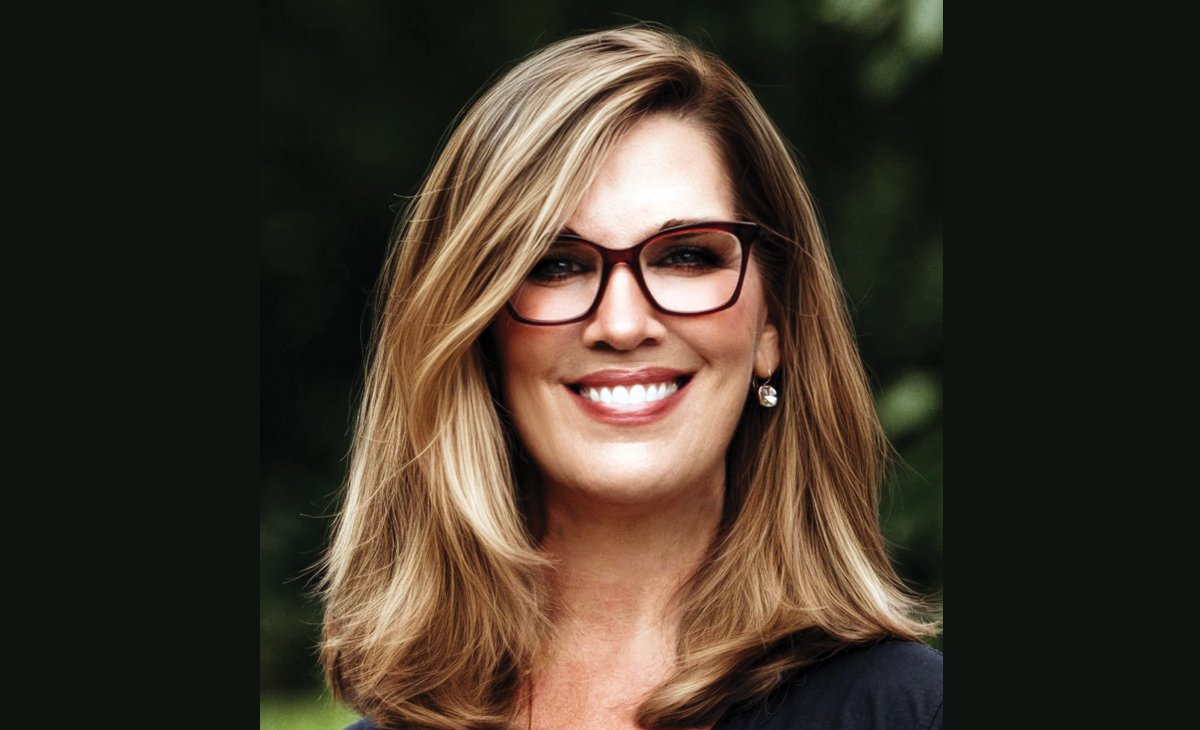
Carolyn Kinzel of Brighter Days Family Grief Center / Photo provided by Kinzel
Q: What led you to found Brighter Days Family Grief Center, and how did your own family’s experience with loss shape your mission?
The vision for Brighter Days Family Grief Center began in 2010, sparked by the deaths of my colleague’s wife and son. As I searched for resources to support him and his daughter, I was struck by how difficult it was to find immediate, accessible help that wasn’t limited to just grief counseling.
Over time, my personal journey deepened that vision. At the tender age of 12, my son lost his father, and I found myself navigating a system that was not built to support families. My son needed much more than grief counseling; he needed compassionate teachers and peers that were educated on grief, and a community of other kids who understood what it was like to lose a parent. For me, I was navigating the logistics of his father’s death while feeling truly inept as a parent to fully understand how to support him. What I didn’t understand then but came to realize later was that I needed an advocate.
I later married a widower whose children had lost their mother at the ages of 8 and 13, and our layered experiences revealed the profound gaps in support, not just emotionally, but financially, logistically, and psychosocially. That’s why our model is like no other; it is rooted in these lived experiences and designed to address the full spectrum of challenges families face. Today, we train other grief centers on this approach, advocating not just for emotional healing, but for the practical, everyday realities that grieving families face.
Q: Statistics show that 1 in 14 Minnesota youth will lose a parent or sibling by the age of 18. Why is it so important for communities to recognize and respond to children’s grief?
Children’s grief is often invisible, yet its impact is profound and lasting. Every year, the statistics shift, and every year we hope to see greater awareness within our schools and communities. The harsh but real truth is that young grievers cannot begin to adjust to the void in their lives when the people and environments they return to, such as school, church, or extracurricular activities, don’t have the proper support in place.
When grief is met with silence or discomfort, it isolates not just the child, but the entire family. This is why we believe that early education and awareness are critical. When we teach children how to talk about their grief to adults and peers who listen with compassion, we start to shape a society that leads with empathy and understanding. When grief and trauma go unaddressed, they can lead to lifelong emotional, physical, and mental health challenges.
Q: Many people assume kids are “resilient” and will naturally bounce back after a loss. What are some of the biggest misconceptions you encounter about how children grieve?
The longer our society fears and misunderstands grief, the more we give grievers no choice but to isolate.One of the most common misconceptions about children and grief is the idea that they are naturally resilient, and that they will simply bounce back after a loss. Grief is a profound life experience, and children are not immune to its impact. While they may move fluidly between emotions of sadness, anger, joy, and even silliness, emotional flexibility is often mistaken for healing.
Additionally, society suggests that if children have strong parental role models, they will be just fine, but those role models are often grieving, too. Expecting parents to carry the emotional weight for the entire family without support is unrealistic and unfair.
What children truly need is a community of care comprised of education, resources, and safe spaces where grief is acknowledged and compassionately addressed. Equally important is that children witness their other family members experiencing this kind of support as well. This is essentially why we are a family grief center and not a counseling clinic. Grief doesn’t disappear but when children are given the language, tools, and relationships to navigate it, from the adults in their lives who are using those same skills too, they are far more likely to develop healthy coping strategies.
Q: What are some of the signs and symptoms that a child may be struggling with grief?
It’s easy to assume that any type of behavior change is a sign that a child is struggling with grief, but it’s not always that simple. We should consider their age, developmental stage, and whether this behavior was present before the loss. Were they academically strong prior to the death and now struggling to focus? Did they adore sleepovers at their best friend’s home and now don’t want to leave their parent overnight? If it is new or intensified behavior, it may be grief related.
At the same time, children don’t just bounce back and the death of a loved one, and the change in family dynamics, routine, and general mood in the home can bring confusion and sadness. In other words, it’s so important to give them permission to feel what they feel, and to equip them with the tools to navigate those emotions in healthy ways. Life has changed drastically, and they deserve to have time and space to come to terms with it.
Q: If grief isn’t addressed in childhood, how might it affect someone later in life, including struggles with mental health or substance use?
I think this is by far one of the most common misconceptions of the cyclical nature of grief. If one is walking around with unaddressed grief and trauma, it can become toxic in our relationships, careers, mental and physical health.
To address it is not just about going to a therapy session. Addressing it in all aspects of their life is equally important because you can have the best grief counselor but still have no one else in your life who understands how to support you. The longer our society fears and misunderstands grief, the more we give grievers no choice but to isolate. Our work at the center is about educating them to understand that there is no fictional timeline in which they will be “over” their grief; we help them learn how to carry it throughout their life with age-appropriate tools that can guide them.
Q: How can parents, caregivers, or teachers best support a grieving child, especially when they may be grieving themselves?
As the adults most present in a grieving child’s life, education and awareness about how grief can affect a child at different ages is so important. For teachers, we host a free virtual webinar, “How to Support Grieving Students” that anyone is welcome to join. We also offer tailored trainings for schools/districts and are happy to discuss how we can implement grief support and education within the schools.
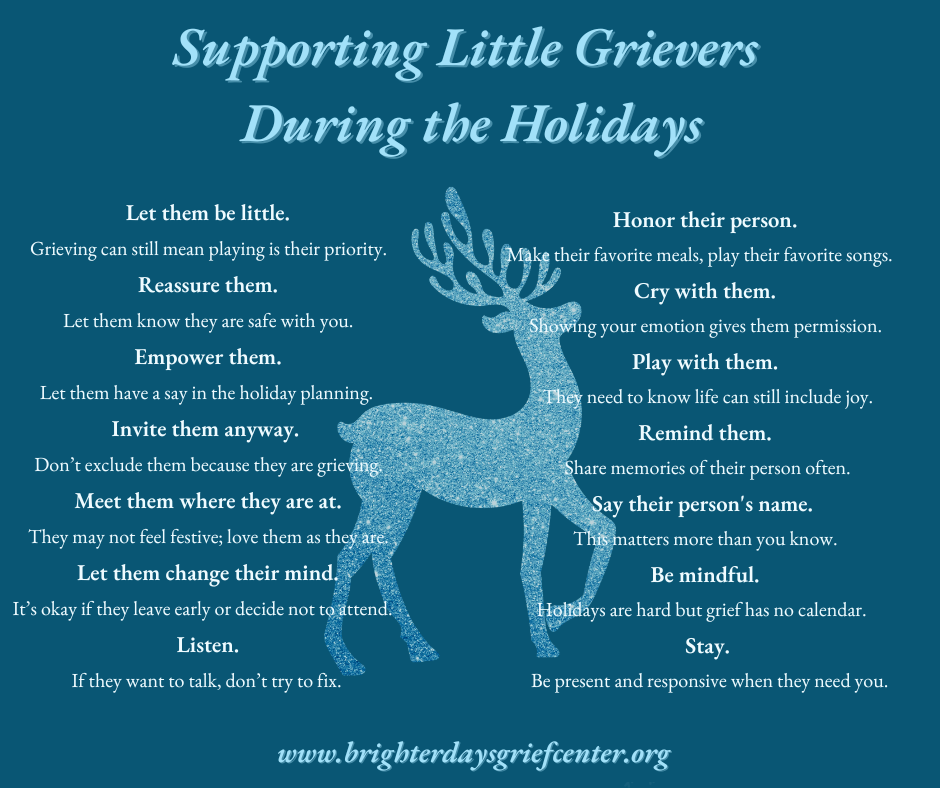
For parents, we offer a virtual webinar “How to support your grieving child while you’re grieving too.” It is so important to find support for yourself and for your children, so that you are not carrying it alone. One of the most powerful things you can do for your child is to model what healthy grieving looks like. Give yourself permission to feel and express your emotions in front of them and give them permission to do the same. When you show that it is okay to cry, to talk about your loved one, to feel all the feelings including the tough ones like abandonment, resentment or even anger, you are teaching them that grief is not something to hide. If you respond with silence, discomfort, or dismissal, they may learn to do the same.
Q: Minnesota has now officially recognized Children’s Grief Awareness Day every third Thursday in November. What does this mean to you, and how do you hope it impacts families across the state?
We are incredibly proud that Minnesota now officially recognizes Children’s Grief Awareness Day every third Thursday in November. I submitted the proclamation back in 2021 after learning it was being honored in other states, and seeing it come to life here is deeply meaningful. It’s more than a symbolic gesture; it is a powerful statement about how we choose to support grieving children and bring their experiences to light, rather than continuing to overlook them.
At Brighter Days, one of our most important roles is helping children become advocates for themselves. Of course, their ability to do this varies by age, but our goal is to equip them with the confidence to re-enter spaces like school after a parent dies and feel prepared to respond to the inevitable questions: Why isn’t your dad here? How did your mom die? How many siblings do you have? These questions come fast and unfiltered, and when children don’t know how to answer, they often retreat into isolation just to avoid discomfort. We want to change that. We help children find language that feels safe and authentic to them so they can tell their story on their own terms. An example is when someone asks, “What was your mom’s name?” We encourage them to say, “Her name IS Julie.” She will always be Julie regardless of her death.
We also encourage them to talk about their person in ways that go beyond the circumstances of their death. Our culture tends to fixate on how someone died, but we encourage all grievers to speak about how their person lived. It is incredibly empowering and emotionally healing to share about their life. While how they died may be an important part of their story, it is never their whole story.
Bringing Children’s Grief Awareness Day to light helps us connect to the adults in their lives who can start bringing some of these tools into their schools, churches, and homes.
Q: For readers who want to get involved or who know a child struggling with loss, where can they turn for resources and support?
If you are an adult supporting a grieving child or seeking support for yourself and/or your family, you are exactly why we exist. Please call us or visit our website to learn more about how to connect and get involved. https://www.brighterdaysgriefcenter.org
For those who wish to get involved, we would love to hear from you! As a statewide organization, we provide training and resources to schools, colleges, nonprofit and for-profit organizations, churches, and other grief-focused groups. Our volunteers are our best ambassadors, and we welcome your time, talent, and skills.
One of the most meaningful ways to engage with our mission is by attending our annual grief conference, All Things Grief, taking place on August 13, 2026. This powerful event brings together professionals, caregivers, and community members for a day of learning, connection, and healing.
Carolyn Kinzel is the Founder and President of Brighter Days Family Grief Center, a Minnesota-based nonprofit dedicated to providing no-cost grief support and programs for children and adults who are grieving the death or terminal diagnosis of a loved one. Motivated by her own personal experiences with grief, Carolyn established a holistic care model that addresses not only the emotional aspects of grief but also the logistical and financial challenges faced by grieving families.