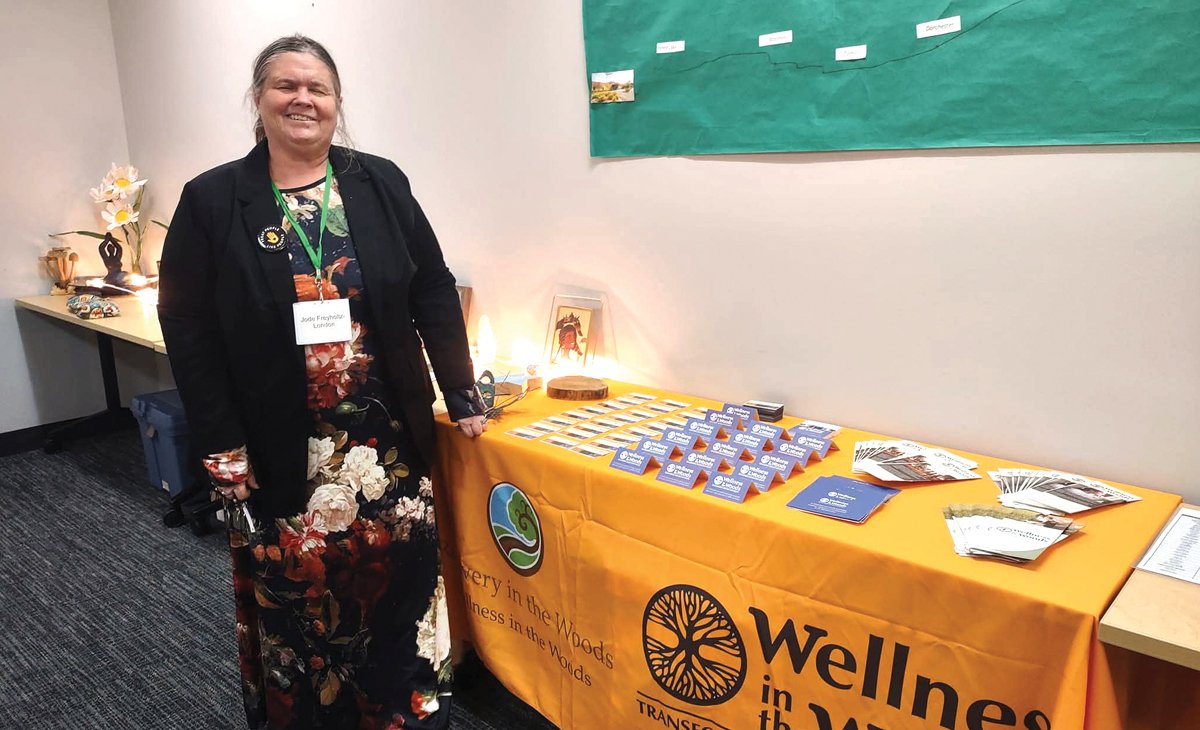
Jode Freyholtz-London of Wellness in the Woods / Photo provided by Freyholtz-London
Jode Freyholtz-London, founder of Wellness in the Woods, a Recovery Community Organization (RCO), shares her recovery journey and career path. Her story begins in a small town with good intentions and unspoken pain.
“I’m from rural Todd County, in central Minnesota,” Jode recalls. “Alcohol wasn’t really part of my family life—maybe a beer when it was cold—but no one struggled with it.”
Jode married young, at just 18. “Getting married just seemed like the right thing to do,” she says. “But after twenty-five years, the marriage wasn’t working. I found myself in a place where I wasn’t allowed to get help. I used alcohol as my hiding place. It was easier not to think.”
Her professional life, once devoted to supported employment programs for people with disabilities, began to crumble around the same time. “I’d worked for several organizations that failed because of fraud,” Jode says. “After I blew the whistle at one, I lost my job. With both my marriage and career ending, I fell into a severe depression.”
In 2007, newly divorced, Jode moved north to Nimrod, Minnesota: “Thirty miles from anywhere and thirty more from any place else.” Life in the woods offered solace: horses, wildlife, and solitude. She and her neighbor, Jess, would sit around the campfire chatting. One night Jess invited her to the local bar. While hanging out at the J and J bar, Jode also found something else—a false sense of belonging.
“There was no judgment there,” she recalls. “Coming from a judgmental relationship that felt good. But of course, alcohol was part of that.”
Between a karaoke party that moved from the bar to her place and a huge drinking party on her 50th birthday, she realized alcohol was an issue. “Thankfully, no one at those parties got hurt, drowned in the pond, or arrested,” she says. “But I was spending too much money and losing too much of myself.”
One of her dear friends, Tom, also struggled with an unhappy marriage and long-time alcohol use. His wife told him that he had to leave so she could think. He called Jode that day and asked, “What should I do?” She told him, “Get an apartment — and maybe we should both just knock off drinking.”
On April 27, 2009, they made a commitment to each other and to God to stop drinking. “That was the end of it,” Jode says simply. Fourteen months later, they married. The two built a life grounded in recovery and purpose. “We both needed a lot of healing,” she says. “He was my best support.” When Tom later developed dementia — what he called “a consequence of his youthful indiscretions” — she cared for him at home until his passing. “Losing him has been one of the hardest things I’ve faced,” she admits. “He passed away about 14 months ago, but I’ve kept my promise — to him and to God — to stay sober.”
She was six years sober when the consumer-run statewide organization she worked for serving central Minnesota started a new requirement: spend three days per week in St. Paul, no expenses paid. “I came home and told Tom, ‘I think we should start our own nonprofit — one that does things with integrity and doesn’t lose the mission.’ He said, ‘Let’s do it.’”
That seed grew into Wellness in the Woods (WITW), a peer-run organization that began as a mental health support network and has since evolved into one of Minnesota’s leading peer-driven recovery initiatives. Tom supported her, getting safe food training to cook conference meals, training as a facilitator, and handling things at home when Jode traveled. “He believed in the organization completely,” she says.
From the beginning, Jode and her team set clear boundaries. “We decided we would never accept pharmaceutical money,” she says. “Our board chair, Dr. Steven Pratt, wears purple every day in memory of Prince—to remind himself and other doctors of the dangers of overprescribing. That’s the kind of integrity we stand for.”
Wellness in the Woods rejects the “silo” approach that separates mental health and substance use. “Most programs only serve one or the other,” Jode says. “We serve the whole person. And we don’t bill for services—because billing requires someone to be in crisis or have a diagnosis. We want to reach people before they get there.”
The organization’s warm line, a free overnight phone line operating from 5 p.m. to 9 a.m., has saved countless lives. But in March 2024, federal funding was cut. “We’ve been surviving on temporary funds donated by Minnesota’s Adult Mental Health Initiatives,” Jode says. “We’re waiting on a new state grant, but we’re not giving up.” Funding cuts reduced the management team from seven people to four, but Jode is proud of their resilience. “My team is solid and trustworthy. Every board member identifies as a peer. When we say 100% peer-run, we mean it.”
In addition to the warm line, WIWT offers all-day virtual peer support accessible to any adult in Minnesota, at no cost, with no appointment. Sessions offered three nights per week help individuals dealing with substance use, incarceration, or long-term recovery. “People on parole can count these online sessions toward their meeting requirements,” Jode notes.
The organization also works inside eight county jails, offering peer support and helping incarcerated individuals develop Wellness Recovery Action Plans (WRAPs). About 25% of the WIWT staff have been incarcerated. Every staff member completes their own WRAP plan during two days of paid training. Jode says, “You have to care for yourself before you can guide someone else.”
The team undergoes regular training—from cultural awareness to trauma-informed care—to reflect Minnesota’s diversity. A new pilot program called Next Step Support connects people leaving treatment or incarceration with a peer who shares their experience. “They meet weekly for up to a year,” Jode explains. “That continuity can make all the difference.”
We serve the whole person. And we don’t bill for services—because billing requires someone to be in crisis or have a diagnosis. We want to reach people before they get there.Data matters, too. “Our communications director loves charts and graphs,” Jode laughs. “We collect data on every program—warm line calls, online sessions, testimonials.”
Testimonials tell the real story. “We’ve had people call saying they were suicidal but reached out to us instead. Just knowing someone cared kept them safe.” The team tracks where calls come from to guide outreach efforts. “During the George Floyd protests, many callers needed support around racial trauma. Now, we’re hearing more anxiety about losing benefits—SNAP, housing, student loans. People are scared. We’re here to listen when they have no one else.”
This fall, Jode launched a Tuesday night grief group after getting trained as a grief counselor and educator. “It’s been deeply needed,” she says. The organization plans to launch an online radio-style podcast dedicated solely to recovery stories. “No politics—just hope,” Jode emphasizes. Under a contract with the Department of Corrections, she and her team visit prisons four times a year, including Oak Park Heights maximum security. “We never ask why anyone’s there,” she says. “We just meet them with respect. No matter what someone’s done, they still deserve support.”
She sees herself as the “big idea” person—out attending conferences, local advisory councils, and meeting with state legislators. As vice chair of the State Mental Health Advisory Council and a member on the Minnesota Certification Board, Jode stays informed on peer recovery policies statewide. WITW collaborates with and participates in numerous statewide events. “In 2024, we had 54,000 interactions with people—at the Minnesota State Fair, county fairs, and recovery walks,” she says. “We’re out there because our biggest challenge is marketing; grants rarely fund it. But getting the word out saves lives.”
Through it all, Jode Freyholtz-London’s mission has remained deeply personal. “Everything we do comes back to integrity and hope,” she says. “I’ve been through loss, addiction, and grief—but I’ve also seen what recovery looks like when people believe in each other. That’s what Wellness in the Woods is all about: peers helping peers and proving that healing is possible for everyone.”
Mary E. Berg is a retired associate professor of clinical education, a resume writer, published author, and poet. Her first poetry collection, A Mystic in the Mystery: Poems of Spirit, Seasons, and Self was published in 2024. Her website is: marybergresumewriter.com.