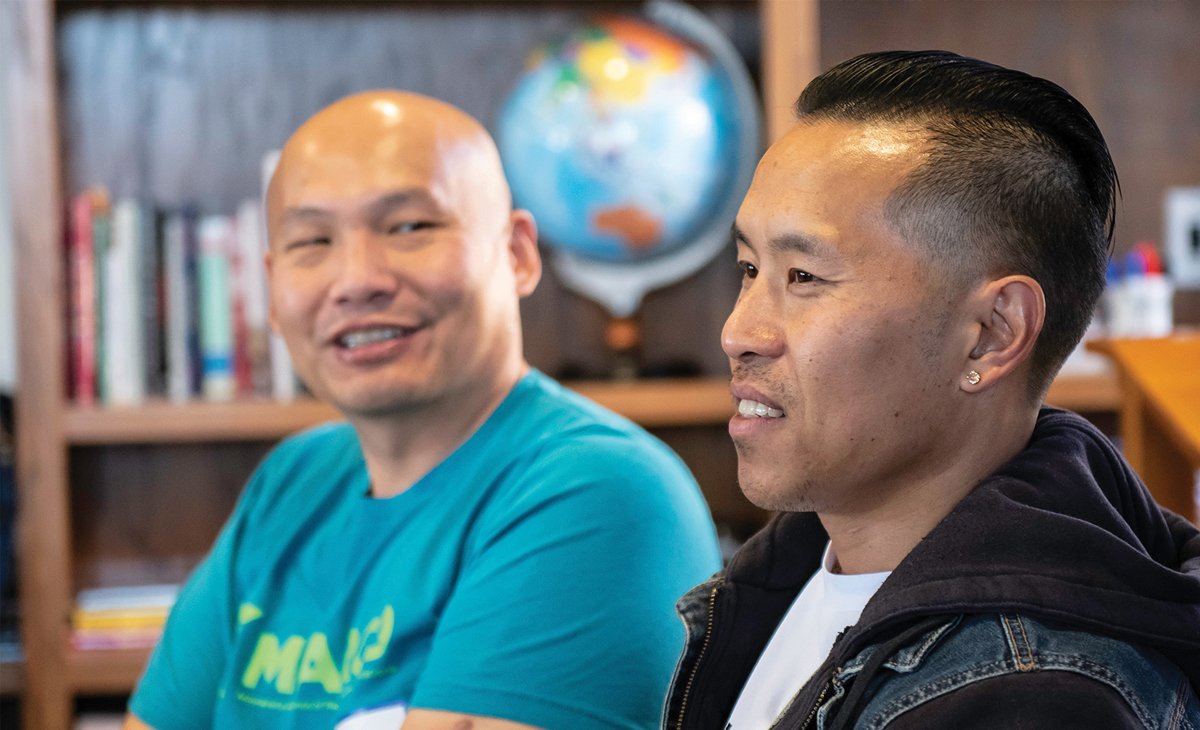
MARCO Board members Khou Vang and Yeng Moua (of Koom Recovery) at a MARCO planning session / Photo by MARCO
Substance use disorder (SUD) is something that isn’t talked about in a lot of communities, especially those of a culture-specific nature. Take, for example, the Hmong people. “Hmong people are known as survivalists and are really resilient. And to add that we have a SUD, it’s kind of like shaming,” Xianna Moua-Yang, co-founder of Koom Recovery, explains to me in a recent interview. “No one wants to claim that they have those issues, and if they do, it is always hidden. “It’s a taboo topic,” interjects Yeng Moua, also co-founder of Koom Recovery.
Koom Recovery is one of the newer “grassroots organizations” established to meet community-specific needs. Collectively known as Recovery Community Organizations (RCOs), they are “the glue which make long term recovery much more possible. They create spaces for connection. They remove barriers,” according to Wendy Jones, Executive Director of Minnesota Alliance of Recovery Community Organizations (MARCO). She continues, “They are there for people no matter where they are in their journey. They know the resources in the community; they understand the cultural traditions if they are a culturally specific RCO.”
This is exactly how Koom Recovery came about. Moua-Yang was seeking her own culturally specific recovery support in her youth and came up empty. She wanted to go to places that she could relate to and feel understood because of her background. So, Yeng Moua, Xianna Moua-Yang, and Mai Moua co-founded Koom Recovery, a 501 (c) 3 non-profit organization, in 2024 “We tailor everything specific to the Hmong community,” Yeng Moua said. “We also try to bring in the components of the Hmong perspective, so we can better serve them.” For example, on a Monday night they host a group called PhoCovery which is tailored around an Asian or Hmong dish. It gives people the opportunity to connect with a tradition they grew up with. They build on those relationships through breaking into groups and using a traditional Hmong ball toss.
Stronger Together
RCOs are “grass root organizations” which have only emerged in recent years. They essentially provide easy access to resources for treatment, offer peer support groups, and provide education. You don’t need insurance, have to have a diagnosis, or even need to be in recovery to access them. Jones states that in 2018 there were only two RCOs in Minnesota: Minnesota Recovery Connection and Recovery is Happening. As more emerged, they began to work together. At that time, Jones was the Executive Director of Minnesota Recovery Connection. It became clear to her that RCOs needed to speak with one voice if they were to get the resources they needed, as state legislators, for example, were more likely to listen to a collection of voices.
What started as an informal partnership between RCOs formalized into MARCO in 2023, which today is a 501 (c) 3 non-profit organization. Jones now serves as its Executive Director.
Establishing Certification
MARCO is slightly different than a regular RCO; its mission is to grow the grassroots recovery movement in Minnesota. One way in which MARCO does this is to provide a certification process for RCOs. They had to set up a framework to do this as RCOs are not traditionally licensed or clinical entities. But it was important to get this in place so that RCOs could build Medicaid for peer support recovery services. The whole certification process is intended to support and help organizations, to help them to learn and grow, and to ensure transparency. There are now 23 certified RCOs in Minnesota, a year after the certification process was launched.
Breaking Generational Trauma
Moua-Yang explained the importance of RCOs and why they are needed: “It’s important to come out there and say, ‘Hey, it’s okay because recovery is possible. And there is nothing to be ashamed of. We are only human.’ We want this [RCOs] so the Hmong community can start seeking healing, help, and support that they need, instead of just continuing this generational trauma of ‘Let’s hide it. Let’s keep it under the rug.’”
I’m not here to challenge the cultures or traditions of the Hmong people…I am here to educate, and I’m here to support and empower.The generational trauma that she speaks of is carried through previous generations who moved to the United States, escaped the troubles of war zones, and didn’t learn how to cope with that unprocessed trauma. “We grew up in a culture utilizing alcohol as part of the traditional ceremonies to bless an ancestor or to call the spirits and, when we got over here, we started indulging because we were in a rich country where we started working and making a lot of money. We just used those culture components as an excuse to indulge in alcohol, and it’s becoming a norm,” Moua explained. Moua-Yang adds: “Rituals and spiritual release—there is always liquor involved.” This now includes baby showers and children’s birthday parties where adults are routinely drinking.
It has not been without challenges to get the leaders of their community to acknowledge that it has become an addiction. Moua explains the issues that he faces: “They either don’t want to accept it, or they don’t want to acknowledge that there’s no difference between a SUD with other substances, like meth, cocaine, heroin, or fentanyl. They don’t differentiate that it is a behavioral issue that caused you to continue to use alcohol, and you can’t wait until the weekend to use alcohol.” He asserts: “This a Hmong problem now. It’s not just a Westernized problem.” But he goes on to clarify: “I’m not here to challenge the cultures or traditions of the Hmong people. It’s a beautiful culture…I am here to educate, and I’m here to support and empower. We are bringing up the next generation to normalize drinking, which is wrong.” Part of Koom Recovery’s outreach work also now involves helping young people with their parents’ consent, to educate before it becomes a problem.
Outreach Work in the Community
Despite some of these challenges, RCOs are growing – and their success stories with them. The Hmong community is believed to be the second largest in the United States (Moua), and Koom Recovery has had their own success stories within their first year of operation.
“We are here to bridge the gap between the recovery resource and the Hmong community,” Moua-Yang states. Koom Recovery has had significant success in working with the Hmong community homeless encampment. They go out three to four times a month, especially on hot days, with cold water and set up a barbeque. They also take hygiene products. They have meals, talk, and build relationships with the people, also with the help of other organizations like Just Hope and church ministries. To date, they have had three people leave the encampment who have had a successful recovery. Moua also talks about the success story they have had with a repeat offender of the judicial system. They helped him to complete treatment, participate in Koom Recovery’s support groups, and navigate the judicial system, resulting in five years’ probation and 120 days of community service vs. a 10-year prison sentence.
Annual Recovery Summit
Jones also shares the accomplishments and future goals of MARCO, beyond the establishment of the certification process now in place for RCOs. The biggest of these events was the hosting of the community-based 1st Annual Recovery Summit this past May. It was a 2-day conference focused exclusively on RCOs with peer-recovery specialists. Jones stressed that it was “a joint learning experience for those folks who are not doing clinical services” but doing peer-to-peer support, advocacy, and public education work in communities. “It was exciting to see these organizations talking with each other, starting collaborations, making connections,” Jones said. The event was attended by 150 people, and Jones hopes that they can build on that next year with a second summit planned, despite some funding-cut challenges.
Bringing it Full Circle
Demonstrating how MARCO’s support has helped RCOs in the community is the story that Jones tells me about MARCO’s advocacy efforts with bringing about a town hall meeting with elected officials to talk about the specific needs of a specific culture: the Hmong people. There has never been such a meeting before that has addressed the needs of Minnesota’s Hmong people and SUDs. It reiterates that Koom Recovery is one of the much-needed grassroots RCOs in the state.
Moua-Yang explains, “Even with my lived experience, I struggled with [how to seek help]. I didn’t know where to seek help; I didn’t know how.” She summed up her work with Koom Recovery: “It’s important for us to be out there and for the community to know that we exist.”
And as Jones says, “We want to tell their story.”
Sharon Chapman is a published author and editor with over fifteen years’ experience. She is the published author of Authentic Aromatherapy (New York: Skyhorse Publishing) and editor in chief for the NAHA Aromatherapy Journal and The Phoenix Spirit. She is also a writing coach. Learn more about her freelance writing, editing, and publishing services.